
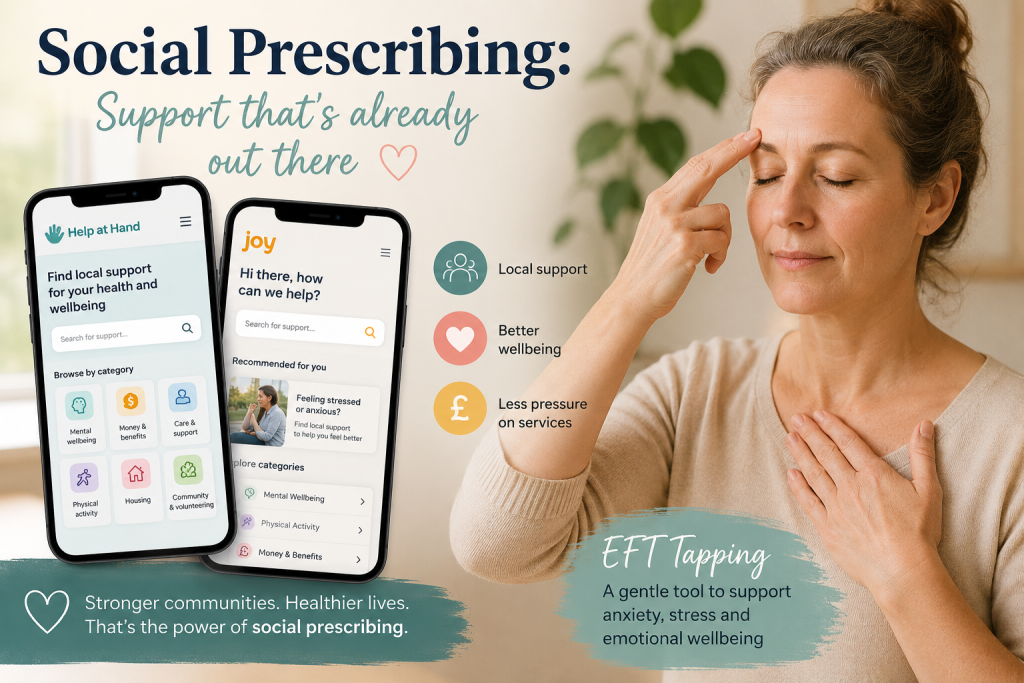
Could Social Prescribing Be One of the NHS’s Best-Kept Secrets?
Yesterday I wrote about anxiety, depression, and the enormous cost that poor mental health places on individuals, families, employers, and the UK economy.
The figures are staggering. Millions of working days are lost each year, NHS services are under increasing pressure, and countless people find themselves trapped in a cycle of poor mental health, isolation, and reduced quality of life.
But what if part of the solution is already sitting quietly within our communities?
What if many of the people sitting in GP waiting rooms do not need another prescription?
What if they need connection, support, purpose, movement, community, or someone to help them navigate life’s challenges?
That is where social prescribing comes in.
What Is Social Prescribing?
Social prescribing recognises that many health problems have social causes and social solutions.
A GP, nurse, or social prescribing link worker can connect someone with local support rather than simply prescribing medication. This might include:
- Walking groups
- Bereavement support
- Debt advice
- Exercise classes
- Volunteering opportunities
- Community gardening
- Arts programmes
- Mental health support groups
- Carer support services
- Wellbeing practitioners
The idea is simple but powerful: improving wellbeing by helping people access support within their community.
Social prescribing has become an important part of NHS personalised care and is now being used across the UK.
The Rise of Digital Social Prescribing
What has fascinated me recently is the emergence of digital platforms such as Help at Hand and Joy.
These platforms help healthcare professionals and patients find local services, activities, and support groups more easily.
According to Joy, the platform now serves more than 19 million patients and is used across a significant proportion of Primary Care Networks throughout the UK. The organisation reports measurable reductions in GP appointments where social prescribing is being used effectively.
Help at Hand was developed to connect patients with trusted health and wellbeing resources and has been adopted by GP practices, hospices, and community organisations. During the pandemic, it became available to hundreds of thousands of patients through NHS partnerships.
This all sounds incredibly promising.
Yet I cannot help wondering how many people have actually heard of these services.
But How Many People Actually Know These Services Exist?
This is the question I keep coming back to.
How many patients know they can ask about social prescribing?
How many people struggling with anxiety, loneliness, depression, chronic illness, caring responsibilities, grief, or life transitions know there may already be local support available?
How many GPs routinely discuss social prescribing during appointments?
How many people leave a surgery with a prescription when they might also benefit from a referral into their local community?
I suspect awareness remains far lower than it should be.
Why This Matters
Research and case studies suggest social prescribing can reduce pressure on GP surgeries and emergency services while improving wellbeing.
As someone who has lived with serious chronic illness for most of my life, I understand that health is rarely just physical.
When I was diagnosed with autoimmune hepatitis at seventeen, I needed medical treatment.
But I also needed hope.
I needed support.
I needed connection.
I needed tools that helped me manage anxiety and fear.
Medicine saved my life.
Community helped me live it.
A Personal Perspective
I am currently training and working towards further qualifications in Emotional Freedom Techniques (EFT), often called tapping.
My hope is that one day I will be able to work more closely with schools, community organisations, and social prescribing networks so that people can access additional emotional support before problems become crises.
As someone who is disabled, I have discovered that finding the pathway into these systems is not always straightforward.
How does a practitioner become visible?
How do community organisations get listed?
How do healthcare professionals discover what is available locally?
How do patients find support if nobody tells them it exists?
These are questions many small practitioners and community organisations are trying to answer.
While researching social prescribing, I have often found myself wondering how practitioners become part of these networks and how patients discover the support that already exists. Greater visibility for both patients and providers could help unlock some of the enormous potential that social prescribing offers.
Where Could EFT Fit Within Social Prescribing?
One area that particularly interests me is the potential role of Emotional Freedom Techniques (EFT), often known as tapping, within social prescribing pathways.
EFT combines elements of cognitive therapy, exposure techniques, and gentle tapping on acupressure points while focusing on a specific issue. It is increasingly being used by practitioners to support people experiencing anxiety, stress, overwhelm, trauma, chronic illness adjustment, low self-esteem, and emotional challenges.
As an EFT practitioner, I am still on my own learning and healing journey. I am now qualified as an EFT Practitioner but am currently working towards further qualifications and hope one day to be listed on social prescribing platforms such as Joy and Help at Hand, making it easier for people to find support within their local communities.
One thing I have discovered is that the pathway for practitioners is not always obvious.
How do small wellbeing providers become visible?
How do they demonstrate quality and safety?
How do they connect with social prescribers and healthcare professionals?
These are important questions because many talented practitioners may have valuable support to offer yet struggle to gain entry to established referral networks.
EFT is not a replacement for medical care, mental health services, or professional psychological treatment where these are required. However, it may have a valuable role alongside existing services as part of a broader, person-centred approach to wellbeing.
The future of healthcare may not simply be about treating illness.
It may be about helping people reconnect with community, purpose, resilience, and hope.
What I Would Like to See
As someone who has spent much of my life navigating chronic illness, disability, anxiety, and recovery, I would love to see social prescribing become as familiar to patients as receiving a prescription.
Many people know they can ask their GP for medication.
Far fewer know they can ask about community support, wellbeing services, local groups, volunteering opportunities, exercise programmes, or emotional support that could help address the root causes of how they are feeling.
I would like every GP surgery to:
- Display information about social prescribing prominently in waiting rooms.
- Explain social prescribing options during consultations where appropriate.
- Make it easy for patients to self-refer to local services.
- Signpost trusted wellbeing practitioners, community groups, and charities.
- Help patients understand that support exists before they reach crisis point.
I would also like to see clearer pathways for practitioners.
At present, many skilled and caring practitioners are willing to help but are unsure how to become visible to social prescribers and healthcare professionals.
Could there be a clearer national pathway?
Could there be more support for small community providers?
Could there be a simpler route for qualified practitioners to demonstrate quality and safety?
These are conversations worth having.
If we genuinely want prevention rather than crisis management, we need to make it easier for patients and providers to find one another.
A Challenge for the Future
If social prescribing is genuinely going to become part of the future NHS, then awareness must improve.
Patients need to know it exists.
GPs need confidence in referring.
Community providers need simpler routes to become visible.
And policymakers need to recognise that prevention is often far less expensive than crisis intervention.
Imagine if every person struggling with anxiety, loneliness, stress, grief, low confidence, chronic illness, or life transitions knew exactly where to find support before they reached breaking point.
Imagine if every GP surgery had access to a thriving network of trusted local organisations and practitioners ready to help.
Imagine if support was not something people discovered by accident, but something they were routinely offered as part of their healthcare journey.
That feels like a future worth building.
Social prescribing is not just an NHS initiative.
It is a recognition that healing often happens in communities, not just clinics.
And if we are serious about reducing the human and financial cost of anxiety, depression, loneliness, and chronic illness, then we need to make social prescribing as well known as the prescription pad.
The support is already out there.
The challenge now is helping people find it.
Lucinda Parker Roberts
This Healing Feeling
If anxiety, stress, overwhelm, low mood, or a challenging life experience are affecting your wellbeing, you do not have to navigate it alone.
As an EFT International Accredited EFT Practitioner, I work with people who are looking for practical tools to help them feel calmer, more confident, and more in control of their emotional wellbeing.
To learn more about EFT, read client stories, access free resources, or enquire about working with me, please visit:
If you have any questions about EFT or would like to find out whether it might be right for you, I would be delighted to hear from you.
And if you found this article helpful, please consider sharing it. You never know who might need to discover a new tool for healing today.